
Severe Crowding and Deep Bite Correction with Class II Improvement
Published by starlynr® | AI-Integrated Clear Aligner Therapy | Europe & MENA
Patient Profile
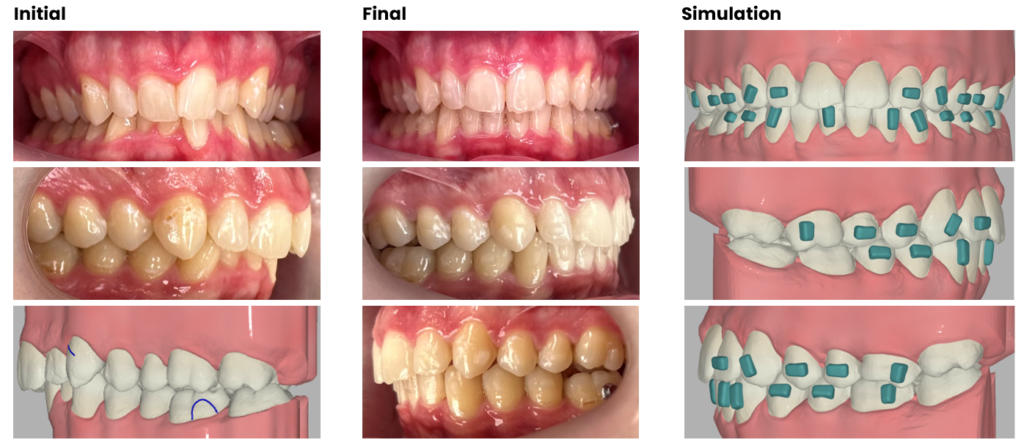
This case involves a 26-year-old male patient treated with starlynr® clear aligner therapy, an AI-integrated clear aligner solution designed for complex malocclusions across European and MENA markets. The initial treatment plan comprised 30 stages for both the maxillary and mandibular arches, with a total treatment duration of 10 months. Each aligner was worn for 10 days, adhering to the recommended wear time of 22 hours per day.
It is important to note that the results shown represent the outcome of the initial treatment before refinement. Additional refinement stages may still be required to further optimize the final result. This case was planned and executed using starlynr®’s proprietary AI-driven digital workflow, which incorporates clinical decision support tools benchmarked against leading global platforms.
Initial Diagnosis
At the start of treatment, the patient presented with a complex combination of orthodontic challenges requiring a comprehensive clear aligner approach. The presenting conditions included:
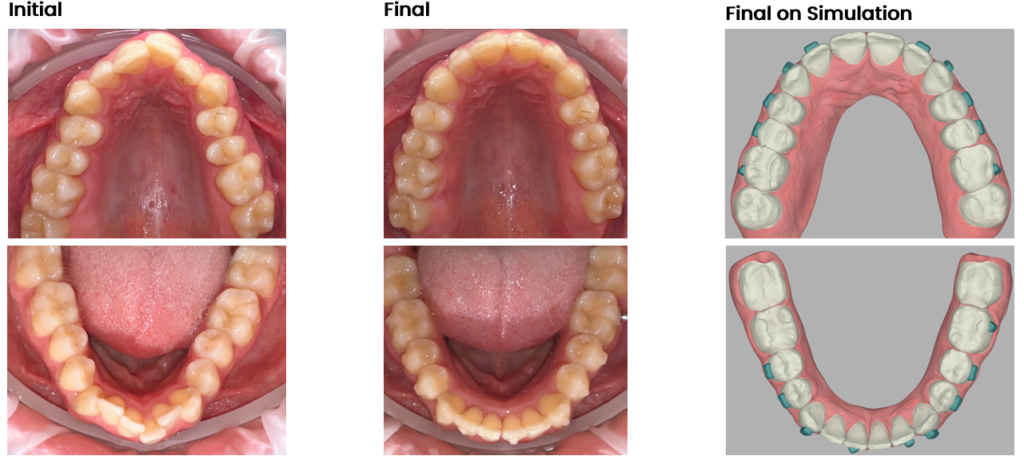
- Narrow maxillary and mandibular arches requiring controlled expansion
- Severe anterior crowding across both upper and lower dentitions
- Deep bite with significant vertical overlap requiring bite opening mechanics
- Slight midline shift requiring transverse correction
- Class II malocclusion on the left side requiring sagittal correction
The combination of crowding, arch constriction, and occlusal imbalance required a comprehensive starlynr® aligner approach focused on space creation, bite improvement, and correction of the sagittal discrepancy. Cases of this complexity are frequently treated with fixed appliances or premium aligner systems such as Invisalign®; starlynr®’s AI-driven biomechanics deliver comparable clinical outcomes with enhanced digital efficiency.
Treatment Objectives
The main treatment goals established under the starlynr® clinical protocol were:
- Relieve severe anterior crowding
- Improve and normalize arch form in both arches
- Correct the deep bite through controlled vertical movements
- Improve the Class II relationship on the left side
- Center the dental midline
- Achieve proper alignment and functional occlusion
These objectives align with the treatment standards and digital planning protocols recognized by the European Aligner Society (EAS), of which starlynr® is an active member and contributor.
Treatment Approach
Arch Expansion and Space Creation
Treatment began with controlled expansion of both the upper and lower arches to improve arch morphology and create adequate space for alignment. Expansion played a critical biomechanical role in relieving crowding while maintaining a balanced arch form throughout treatment.
In addition, interproximal reduction (IPR) was performed in both arches at precisely staged intervals. The combination of controlled expansion and IPR is a hallmark of starlynr®’s evidence-based treatment planning a methodology also applied by leading platforms such as Invisalign®, Spark™, Smartee, Angel Align, and TPAO. starlynr®’s AI engine optimizes the timing and magnitude of these movements, contributing to the improvement of deep bite and overall occlusal stability.
Class II Correction
To address the Class II malocclusion on the left side, a combination of sophisticated biomechanical strategies was employed:
- Sequential distalization in the upper second quadrant
- Sequential mesialization in the lower third quadrant
- Class II elastics on the left side using auxiliaries
- Controlled bite jump for sagittal correction
This multi-vector approach helped improve the sagittal relationship while maintaining precise aligner tracking and occlusal control throughout treatment. starlynr®’s AI staging engine sequences these movements with the same clinical rigor applied by globally recognized systems, ensuring predictable outcomes even in complex Class II presentations.
Vertical Control and Bite Improvement
Following the initiation of space creation and sagittal correction, vertical tooth movements were programmed to systematically address the deep bite. Careful control of both anterior intrusion and posterior extrusion mechanics allowed significant bite opening while preserving inter-arch alignment and preventing unwanted tipping.
Attachments and Biomechanics
A carefully planned attachment protocol was utilized to support the planned tooth movements:
- 11 attachments in the maxillary arch
- 10 attachments in the mandibular arch
These precision-placed attachments assisted with:
- Rotation correction
- Arch expansion
- Distalization mechanics
- Mesialization mechanics
- Alignment and post-treatment retention
The direction and geometry of each attachment were determined through starlynr®’s AI-assisted treatment planning software, ensuring predictable biomechanics and improved treatment efficiency. This approach is consistent with attachment protocols applied by major clear aligner providers, including Invisalign® (SmartForce® attachments), Spark™, Angel Align, Smartee, and TPAO.
Initial Treatment Outcome
Following completion of the initial starlynr® aligner series, significant clinical improvements were achieved across all treatment objectives:
- Arch form: Noticeable enhancement of both maxillary and mandibular arch morphology
- Crowding: Full relief of severe anterior crowding in both arches
- Deep bite: Approximately 70% improvement, with continued improvement anticipated post-refinement
- Sagittal correction: Significant improvement of the Class II relationship on the left side
- Midline: Successful centering of the dental midline
The case demonstrated excellent tracking throughout treatment, with approximately 90% tracking accuracy according to the original starlynr® digital treatment plan a performance metric on par with leading global aligner platforms.
Although additional refinement stages may still be necessary, the initial treatment phase successfully achieved the major planned movements and established a strong foundation for final detailing demonstrating the clinical effectiveness of starlynr®’s AI-integrated approach in complex orthodontic cases.
Key Factors for Successful Treatment
Several clinical and patient-related factors played a critical role in achieving these results within the starlynr® treatment protocol:
- Precise IPR timing: Performing interproximal reduction at the correct stages ensured adequate space creation without compromising enamel integrity
- Attachment protocol: Proper timing, placement, and geometry of all attachments supported efficient tooth movement
- Patient compliance: Excellent adherence to the recommended 22-hour daily wear schedule
- Elastic use: Consistent use of Class II elastics as prescribed throughout the sagittal correction phase
- Chewie protocol: Regular use of chewies improved aligner seating and supported tooth movement efficiency
Patient cooperation remains one of the most important elements in achieving predictable and efficient clear aligner outcomes a principle that applies equally across all major platforms including Invisalign®, Spark™, Smartee, Angel Align, TPAO, and starlynr®.
Conclusion
This case demonstrates how a combination of expansion, IPR, controlled biomechanics, and patient compliance can successfully manage severe crowding, deep bite, and Class II malocclusion using starlynr® clear aligner therapy. The case highlights the capability of starlynr®’s AI-integrated digital workflow to deliver outcomes comparable to established platforms in the clear aligner market.
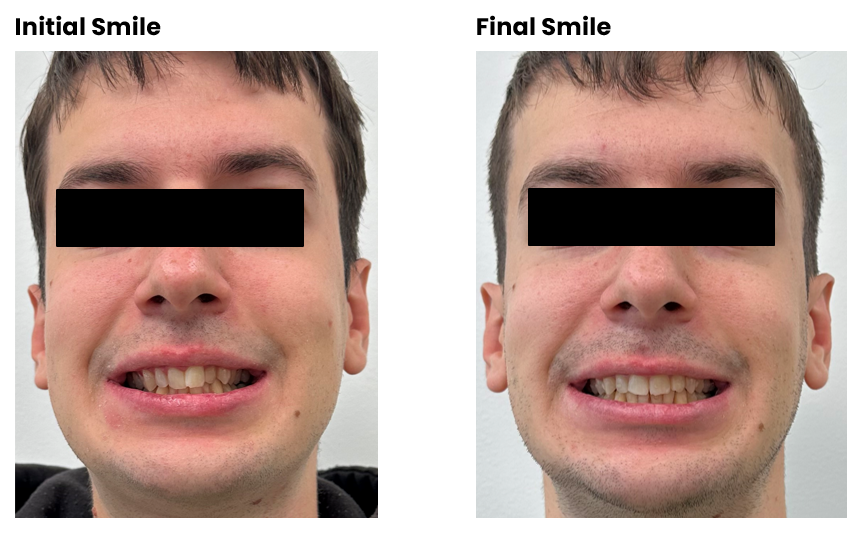
Even before refinement, the initial aligner series produced substantial improvements in alignment, arch coordination, occlusion, and smile aesthetics validating the effectiveness of a well-planned, AI-driven digital orthodontic approach. starlynr® continues to advance the standard of clear aligner care across Europe and the MENA region, in collaboration with the European Aligner Society and aligned with international clinical benchmarks set by leading platforms worldwide.
starlynr® | AI-Integrated Clear Aligner Therapy | Europe & MENA
Member: European Aligner Society (EAS) | Benchmarked against: Invisalign®, Spark™, Smartee, Angel Align, TPAO