
Case Overview
- Patient Age: 22 years
- Gender: Female
- Chief Complaint: Anterior open bite and dental misalignment
- Primary Treatment Goals: Open bite correction, alignment, and arch development
- Total Treatment Time: 6 months
- Total Number of Stages: 18
- Maxillary Aligners: 18
- Mandibular Aligners: 18
- Recommended Wear Time: 22 hours/day
Introduction
This case demonstrates the treatment of a 22 year old female presenting with a narrow arch form, anterior open bite, and mild crowding using starlynr® clear aligner therapy, focused on transverse arch development, dental alignment, controlled retroclination of the anterior dentition, and selective extrusion of the mandibular anterior teeth to improve overbite without compromising smile esthetics.
A key aspect of this treatment was the decision to avoid extrusion of the maxillary anterior teeth due to the patient’s existing gingival display. Instead, vertical correction was achieved primarily through lower incisor extrusion combined with controlled anterior torque and arch coordination.
Initial Evaluation and Diagnosis
Extraoral Evaluation
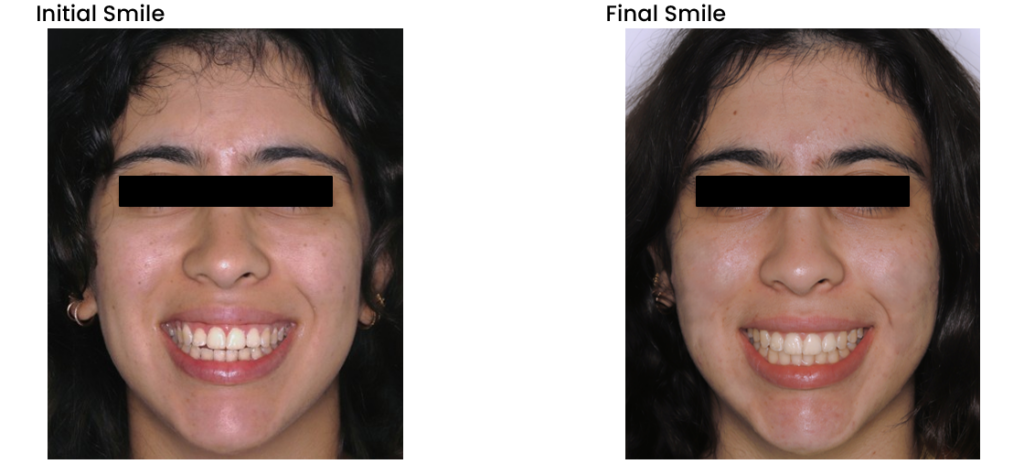
The patient presented with balanced facial proportions and a mildly increased gingival display upon smiling. From an aesthetic standpoint, additional maxillary incisor extrusion could have negatively affected smile harmony and gingival exposure.
Because of this, vertical correction mechanics were carefully designed to avoid increasing the gummy smile while still achieving adequate anterior overlap and functional bite closure.
Intraoral Findings
Clinical examination revealed:
- Anterior open bite
- Narrow maxillary and mandibular arches
- Mild crowding
- Insufficient anterior overlap
- Constricted transverse dimensions contributing to the open bite appearance
The mandibular arch additionally demonstrated a curve discrepancy requiring leveling mechanics. Controlled extrusion of the lower anterior segment was therefore incorporated not only to improve overbite, but also to assist in leveling the mandibular occlusal plane.
Bio-mechanical Considerations
Open bite correction with aligners requires careful force management because aligners naturally Open bite correction with clear aligner therapy, including platforms such as Invisalign, Spark, Angel Align, Smartee, TPAO, and starlynr®, requires careful force management, as aligners naturally tend toward posterior intrusion. While some intrusion may assist bite closure, uncontrolled vertical changes can compromise tracking and predictability.
In this case, the treatment objectives favored:
- Transverse arch development
- Controlled anterior retroclination
- Lower incisor extrusion
- Alignment and leveling
- Preservation of smile esthetics
The treatment plan therefore relied on programmed lower anterior extrusion rather than maxillary anterior extrusion.
Treatment Objectives
- Correct the anterior open bite
- Expand and coordinate both dental arches
- Improve alignment
- Retrocline and retract the maxillary and mandibular anterior teeth
- Extrude the mandibular anterior teeth to establish positive overbite
- Preserve smile esthetics by avoiding maxillary anterior extrusion
- Improve arch form and transverse development
- Achieve stable intercuspation with minimal refinements
Treatment Planning Strategy
Arch Development and Expansion
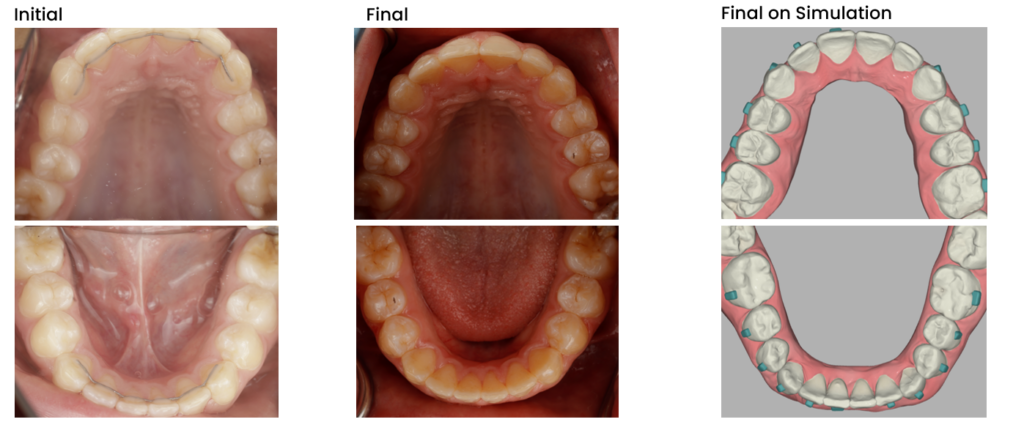
Both maxillary and mandibular arches were expanded to address the constricted arch form and improve transverse coordination.
Arch development played a critical role in:
- Improving arch symmetry
- Creating space for alignment
- Reducing buccal corridor constriction
- Supporting open bite correction biomechanics
- Enhancing smile width and esthetics
Attachments were strategically placed on posterior teeth to improve aligner retention and enhance the predictability of transverse development movements.
Lower Incisor Extrusion
One of the most important components of this case was the selective extrusion of the mandibular anterior teeth.
Rather than extruding the maxillary incisors, the treatment plan utilized lower anterior extrusion to close the bite while preserving smile esthetics and limiting gingival display.
This approach provided several advantages:
- Improved overbite relationship
- Better leveling of the mandibular arch
- Preservation of maxillary smile line esthetics
- Reduced risk of increasing gingival exposure
- More controlled vertical correction mechanics
Lower anterior extrusion with aligners can be difficult due to limited aligner grip and the tendency for insufficient force expression during vertical movements. To improve predictability, attachments were placed on the mandibular anterior teeth to increase aligner engagement and enhance extrusion efficiency.
These attachments improved:
- Retention during vertical force application
- Force transfer to the target teeth
- Aligner seating consistency
- Control of unwanted tipping effects during extrusion
Retroclination and Retraction
Controlled retroclination of both the maxillary and mandibular anterior teeth was programmed during treatment.
The retroclination mechanics assisted in:
- Reducing incisor proclination
- Improving anterior coupling
- Enhancing overbite correction
- Supporting open bite closure
- Improving incisor inclination relative to the occlusal plane
Interproximal Reduction (IPR)
Selective interproximal reduction was programmed to facilitate alignment, improve tooth coordination, and assist in achieving the planned biomechanics.
Maxillary IPR
- 0.2 mm between #15 and #14
- 0.2 mm between #14 and #13
Mandibular IPR
- 0.2 mm between #42 and #43
- 0.2 mm between #43 and #44
- 0.1 mm between #32 and #31
- 0.1 mm between #31 and #41
- 0.1 mm between #41 and #42
The lower anterior IPR served an additional biomechanical purpose beyond alignment. By slightly opening the contact points in the anterior segment, resistance to vertical movement was reduced, facilitating the programmed extrusion mechanics.
Breaking tight interproximal contacts can significantly improve the predictability of lower incisor extrusion with aligners, particularly in cases requiring simultaneous leveling and vertical correction.
Staging Discussion
Proper staging was critical to the success of this case. The treatment progression incorporated:
- Progressive transverse expansion
- Initial alignment and arch coordination
- Controlled lower anterior extrusion
- Simultaneous anterior retroclination
- Final detailing and settling
The sequencing of expansion and anterior vertical correction helped maintain aligner retention and reduced the risk of unwanted posterior open contacts.
Because open bite correction is highly sensitive to force balance, staging was intentionally designed to distribute movements efficiently across the 18-aligner sequence.
Clinical Outcome
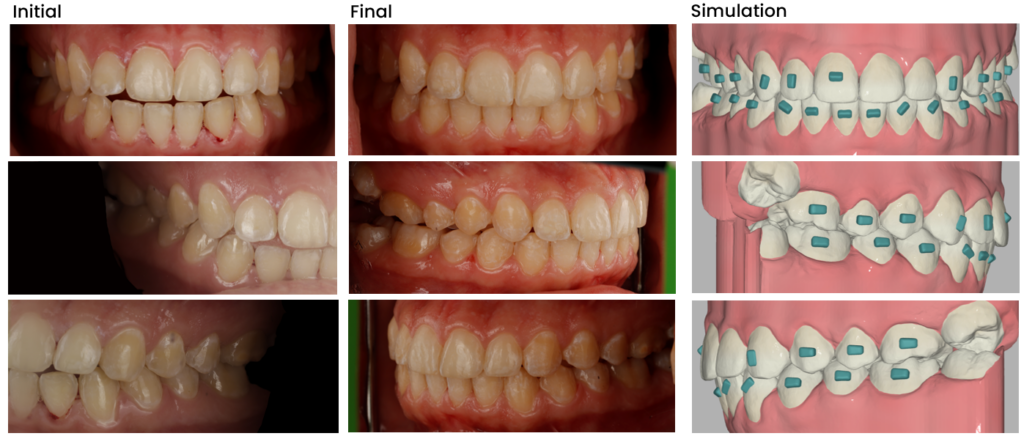
The post-treatment results demonstrated successful achievement of the programmed movements with excellent aligner tracking and minimal need for refinements.
The final outcome included:
- Significant improvement of the anterior open bite
- Successful transverse arch development
- Improved smile width and arch coordination
- Resolution of crowding and rotations
- Achievement of lower anterior extrusion
- Improved anterior overlap and intercuspation
- Controlled incisor inclination
- Maintenance of smile esthetics without increasing gingival display
Importantly, the treatment objectives were achieved without significant mid-course corrections or major additional adjustments.
The case highlights the predictability of carefully staged aligner biomechanics when appropriate attachment design, force planning, and vertical control principles are incorporated.
Bio-mechanical Pearls from This Case
- Lower Incisor Extrusion Can Be Highly Effective in Open Bite Correction
Selective lower anterior extrusion represents an excellent alternative to maxillary incisor extrusion in patients with existing gingival display or gummy smile tendencies. - Attachment Design Directly Influences Extrusion Predictability
Vertical movements with aligners often require enhanced retention and force expression. Proper attachment placement on the mandibular anterior teeth significantly improved extrusion control and aligner engagement in this case. - Expansion and Open Bite Correction Are Closely Related
Transverse deficiency frequently contributes to anterior open bite presentation. Controlled arch development can improve occlusal coordination while simultaneously enhancing smile esthetics. - Small IPR Adjustments Can Improve Vertical Biomechanics
Strategic opening of contact points in the mandibular anterior segment reduced resistance to extrusion and improved movement predictability. - Smile Esthetics Must Guide Vertical Mechanics
Avoiding maxillary anterior extrusion was essential in maintaining a balanced smile display and preventing excessive gingival exposure.
Conclusion
This case demonstrates the successful clear aligner therapy management of an anterior open bite through transverse arch development, controlled anterior retroclination, and selective lower incisor extrusion, consistent with European Aligner Society biomechanical principles.
By balancing biomechanics with facial esthetics, the treatment achieved functional bite closure while preserving smile harmony and gingival display.
The case further emphasizes that predictable open bite correction with clear aligner therapy depends not only on the programmed movement itself, but also on staging strategy, attachment optimization, contact management, and precise vertical force control.
With appropriate planning and biomechanical understanding, clear aligner therapy can effectively manage complex vertical discrepancies while maintaining high esthetic standards and excellent patient comfort.

Published by starlynr® • starlynr.com • © 2026 starlynr®. All rights reserved.
The following records and treatment simulation demonstrate the planned biomechanics, staging strategy, and clinical outcome achieved throughout starlynr® aligner therapy.